AI Video Prompt Templates by Genre: Horror, Romance, Sci-Fi, Documentary, and Promo
A blank prompt box invites vague adjectives and wasted credits. Genre templates fix that by locking the parts that create mood—light, camera attitude, and atmosphere—while you swap the subject. This guide gives you copy-ready skeletons for five genres plus food, plus a short method for adapting them without collapsing the look. It sits alongside the blog’s cinematic AI video prompts collection and the broader text-to-video workflow.
In Avocadio you can paste these into Text to Video, start from a starter prompt and genre-tune it, or pair a still with Image to Video when identity matters. Save keepers in history so your personal template library grows shot by shot.
Create this in Avocadio — Paste a genre skeleton, swap in your subject, generate a short cinematic clip, and keep the winner in history. Try Avocadio
The universal skeleton
Use this order every time:
“Subject with one concrete detail, one action, one camera move, light and time of day, atmosphere, cinematic style.”
Rules that keep templates reliable:
- One primary subject (a hallway, two cups, a product, a corridor)—not a crowd unless the crowd is the point.
- One camera verb (push-in, orbit, drift, static with subtle parallax). Competing moves muddy the result.
- Light does most of the genre work. Horror without hard shadows still looks like a hallway; romance without warm practicals still looks like a window ledge.
If a take fails, change one module only. Diagnose with the lighting for AI video checklist before you rewrite the whole sentence.
Horror template
Skeleton: “Ordinary space at night, one subtle wrong detail, slow push-in, hard side key light, deep shadows, almost no fill, cinematic horror tension.”
Filled example: “Empty motel hallway with a flickering exit sign, slow push-in toward the last door, hard side light, deep blacks, quiet cinematic dread.”
Why it works: the ordinary space lowers the viewer’s guard; the wrong detail (flicker, ajar door, wrong reflection) creates unease; removing fill keeps contrast. Common mistake: stacking jump-scare props in one prompt. One wrong detail beats five.
Variation for object horror: “Child’s music box on a dusty dresser, lid slowly opening, static camera with slight creep forward, single practical lamp, hard falloff, cinematic unease.”
Romance / warm drama template
Skeleton: “Intimate detail or soft silhouette, gentle camera drift, warm practical lights, soft haze, shallow depth of field, cinematic romance.”
Filled example: “Two coffee cups on a rainy window ledge, soft condensation trails, slow lateral drift, warm café practical light, intimate cinematic mood.”
Why it works: small scale reads clearly on phones; warm practicals signal intimacy; drift feels unhurried. Common mistake: wide establishing shots of entire city skylines—romance collapses into travel B-roll. Keep the frame close.
Variation: “Hands exchanging a house key on a wooden porch, golden hour sidelight, gentle push-in, soft haze, tender cinematic tone.”
Sci-fi template
Skeleton: “Futuristic interior or object, slow orbit or measured push-in, cool rim light, clean reflections, light volumetric haze, cinematic sci-fi.”
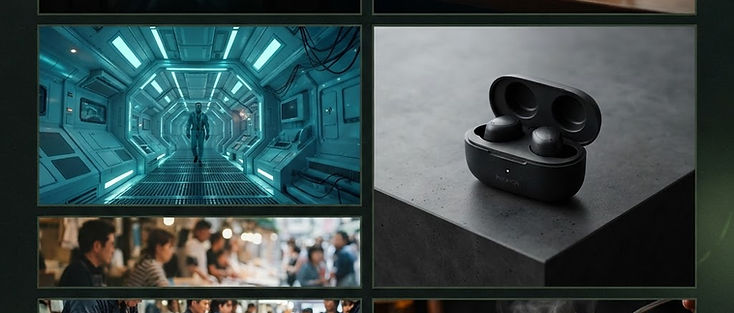
Filled example: “Minimal spacecraft corridor with cool cyan rim light, slow push-in down the center line, soft haze, precise reflective floors, cinematic sci-fi.”
Why it works: cool rim plus reflections sell “future” faster than naming fictional brands. Common mistake: overcrowding the prompt with UI panels and alien languages—letterforms warp. Describe light and materials, not readable screens.
Variation: “Desk-sized prototype device with a soft pulsing glow, slow orbit, cool rim and dim warm bounce, clean lab aesthetic, cinematic tech demo.”
Documentary / observational template
Skeleton: “Real-world location type, gentle handheld feel, natural available light, restrained motion, observational documentary cinema.”
Filled example: “Morning fish market aisle, gentle handheld feel, natural window light from the left, people moving through soft focus background, observational documentary cinema.”
Why it works: available light and restrained motion feel honest. Common mistake: adding “epic drone” language—that flips the genre into travel promo. Stay eye-level and patient.